Jumana Manna
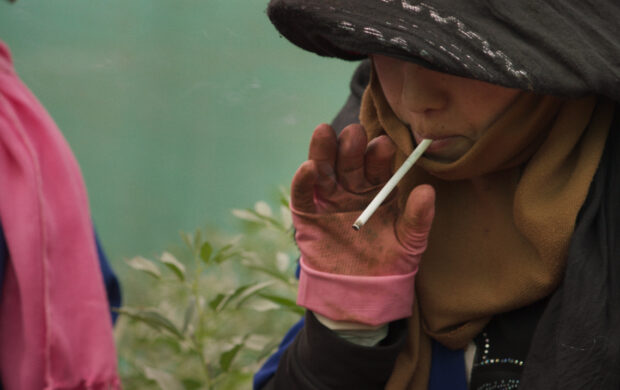
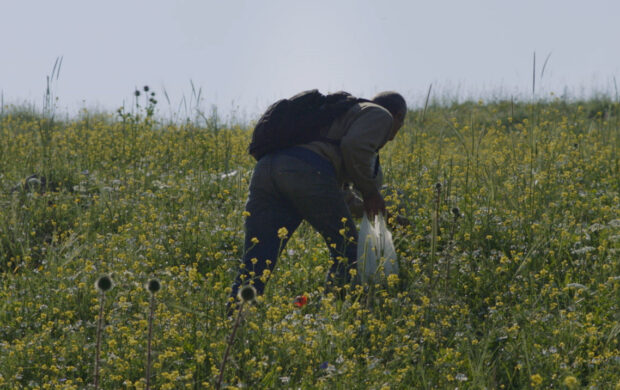
In two of her feature films, Foragers (2022) and Wild Relatives (2018), the solid element that constitutes the earth is transformed into a shifting psychological landscape where the harshness of life can be confronted through acts of resilience. Thus, harvesting becomes a way of communicating emotions non-verbally; cooking creates a soothing social bond; walking fosters authentic exchanges. Through these actions, the land becomes a comforting entity, a special place, even as it finds itself dangerously privatised. Every movement of the harvesters is monitored, restricted and supervised by Israeli soldiers’ patrols and interrogations. While Arabs are forbidden from gathering za’atar because “za’atar is Israel”, Jumana Manna doesn’t turn this outrageous state of affairs into social commentary but attempts to guide us towards another place, like in a Western. Here, the Wild West is a field of fresh grass strewn with rocks, and the conquest on horseback is a trek on foot by a couple determined not to comply with the ban. Through Foragers’ humorous tone, Manna’s focus emerges: to overturn, for the duration of a film, the ‘law of the strongest’, and to make small, everyday gestures the driving force of the action, where the characters’ non-violence is, paradoxically, what constitutes a breach. The question of desire also traverses the narrative framework as a space for urgent exploration, allowing as it does for movement and openness towards others, even if this is not without ambiguity – for gestures of love and interpersonal relations can be subject to colonial power, too.
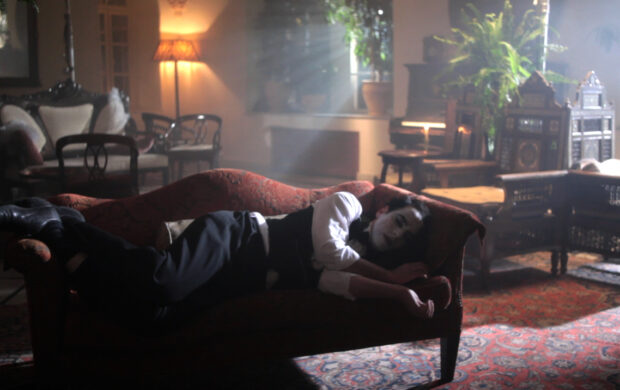
This is the case in the film The Umpire Whispers (2010), in which Jumana Manna shares personal memories with her former swimming coach. She recalls the power he wielded over her, and the words and gestures that shaped her as a young woman. Within an ambiguous relationship that oscillates between pedagogy, emancipation and fascination, the sequences in which we see a massage performed on his male body allow for a cathartic subversiveness. Indeed, within the same sequence, the editing alternates between sensual stimulation and painful confessions, such as when Jumana reveals that she would swim very fast and break her record whenever she saw the words ‘Death to Arabs’ scrawled on one of the swimming pool walls. Survival, here, depends on performance and the act of diving underwater can be read metaphorically as the way one inhabits another identity.
Manna speaks Hebrew, having lived in Jerusalem. Her adolescence – like that of other Palestinians – was one in which the self was forced to become double, where donning the attire of the other allows you to preserve what little remains of your own identity. This tiny proof of existence in the present, is transformed into a utopia in A Magical Substance Flows Into Me (2016): a film about the German Jewish musicologist Robert Lachmann who, in 1936, fearing that they might be lost forever, began recording the instrumental sounds he heard in Jerusalem and its surroundings. These recordings formed the basis of a twelve-part radio series, with each episode showcasing the musical traditions of a different community: Kurdish, Moroccan and Yemenite Jews, Samaritans, members of urban and rural Palestinian communities, Bedouins and Coptic Christians. This is a utopia, for in the film, the imagination that transpires through a rational reconstruction effort – namely, the cataloguing of ancestral Palestinian music – gradually reveals the filmmaker’s sole true political demand: not to disappear. Indeed, all that remains of Palestine are tarnished, stony, dusty remnants, shrunk by empty promises, broken agreements and bombings. War never reinvents the gaze; it freezes it in place.
It is from this starting point that artists have sought to create something – images, in particular. Jumana Manna’s images often function as proto-stories, representing the uncertain, transitional period between a pre-colonial and a post-colonial era that is still unfolding – one characterised by violence with no end in sight, unjustly passed down from generation to generation as an unquestioned truth.
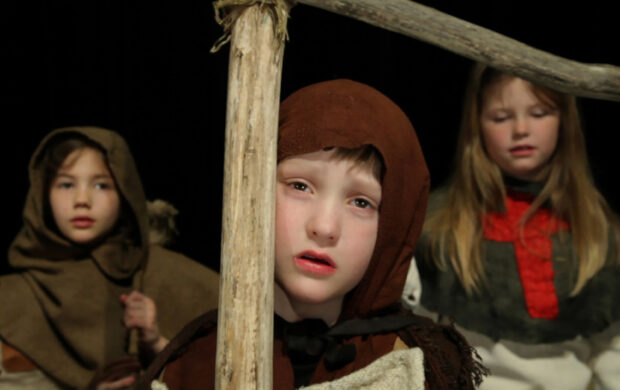
Thus, the choice to feature children in The Goodness Regime (2013) and to use archives to better dissect the hypocrisies that lead to the confusion of myth and history; or, again, to use the imagery of the group portrait that is staged in A Sketch of Manners (2013), where the protagonists don Pierrot costumes to perform, to the bitter end, a final masquerade, acts as a reminder, or rather as a warning. For Manna, vigilance is about never allowing oneself to be trapped by appearances, and always remembering that seduction has the power to destroy. One of Manna’s earliest films, Blessed Blessed Oblivion, is a visual collage with an ironic soundtrack that weaves, through the confessions of a young mechanic who loves the gym, conflicting parallels between Palestinian resistance poetry, toxic masculinity and the fatalism of being a body born in the wrong place. Inspired by Kenneth Anger’s Scorpio Rising (1963), the statement is clear: it is sometimes from the greatest rage that the impulse for gentleness is born.
This is an impulse that goes hand in hand with humour. Irony features heavily in Manna’s work, but it is never sarcastic; on the contrary, it highlights absurdity without causing offence and creates a sense of complicity between the audience and the characters. Just like the story told by the character in A Magical Substance Flows Into Me: ‘Today, I bumped into my Iraqi friend, Yitzhak, in the changing rooms. For some time now, he’s been trying to convince me to be optimistic. Whenever he talks to me about politics, I tell him the situation is terrible and just keeps getting worse… Anyway, today, whilst we were getting changed, he was singing. ‘So, what are you singing?’ I asked him. “Oum Kalthoum,” he replied. I asked him, “Which Oum Kalthoum song?” He said, “You Oppress Me.” I said, “Ah…” It is in a light-hearted tone, in the course of a mundane, everyday conversation, that Manna chooses to describe the situation.
Faced with the intractability of oppressive situations, the artist employs a strategy rooted in humanism and the interplay between documentary and fiction. By writing fictional dialogue within a documentary that surveys a given period whilst distilling key information essential to the plot’s development, Jumana Manna crafts a unique montage in which the narrative’s timeline consistently blends the personal with the collective. This co-dependence recalls the final sequence of director Elia Suleiman’s film, Chronicle of a Disappearance (1996): a couple, the director’s parents, sit in front of a television screen which shows the Israeli flag fluttering in the air to the thunderous rhythm of the national anthem. This is an ordinary scene that seems innocuous, except that the couple are asleep and each is snoring loudly, as if the only way left to resist were through a coma. While Jumana Manna’s characters have not yet fallen into a deep sleep, and while her films still invoke hope, what we are left with is the artist’s lucidity, and the feeling that making films is akin to one’s entry into the world: it is impossible to emerge fully unscathed.
Guslagie Malanda
[1] See Anne Dufourmantelle, Puissance de la douceur, Ed. Manuels Payot, 2013.
Discussion with Jumana Manna following the screening of Foragers, Thursday 26 March at Saint-André des Arts, hosted by Lola Maupas, researcher in cinematographic studies.